DAMAC Properties: The High-Yield Strategy Behind 8% Returns
Executive Summary
DAMAC delivers genuine yield potential, particularly in Business Bay, where its branded product commands rental premiums that support the numbers it publishes. The cost of that yield is construction-risk patience, a longer average hold period than comparable Emaar or Meraas stock, and a resale market that is thinner at exit. Investors who understand those trade-offs and price them in can do well here. Investors who don't often don't.
Buying off-plan in Dubai means choosing a developer as much as a property. DAMAC Properties makes that choice interesting. The company is one of the UAE's largest private developers, with a balance sheet large enough to underwrite multi-billion-dollar masterplans and a marketing machine bold enough to put Versace, De Grisogono, and a tropical island theme on towers in Dubailand. For investors, the central question isn't whether DAMAC can sell an apartment. It's whether the returns survive contact with reality.
Track Record: Volume With Caveats
DAMAC has delivered thousands of units across Dubai, including Damac Hills, Akoya Oxygen, and multiple towers in Business Bay and DIFC-adjacent corridors. Those communities exist, are occupied, and function. That is not nothing in a market where some developers have evaporated entirely.
The honest complication is timing. DAMAC has a documented history of handover delays, running anywhere from several months to multiple years on earlier projects. Delivery schedules have improved since the 2020 period, partly because DAMAC restructured its contracting approach and partly because post-pandemic demand gave the business reasons to accelerate. But investors should treat any DAMAC handover date as a planning estimate, not a hard commitment, and stress-test their cash flows accordingly.
Construction quality sits in the mid-premium bracket. Finish standards are noticeably higher when a brand co-signs the interiors, which is the explicit logic behind De Grisogono on Canal Heights 2 and the Versace collaboration on earlier towers. Without that branded overlay, finishes have historically been variable across handover cohorts.
What They're Known For: Lifestyle Narrative and Branded Premiums
DAMAC's core competency is positioning. The company understood earlier than most that Dubai buyers, particularly international investors, were purchasing a story alongside a square metre count. Tropical island themes, Swiss jewellery branding, celebrity-designed amenity stacks: these are not incidental. They are the product.
This creates a genuine bifurcation. In Business Bay, that positioning works. Canal Heights 2 is a real case: a studio from $335,000 with De Grisogono interiors, 11-foot ceilings where the market standard is nine, and a canal-facing location within walking distance of the metro. At an estimated 7% ROI, the branded premium justifies the numbers because the short-stay rental market will pay for it. The spec gap is real and translates to achievable rent.
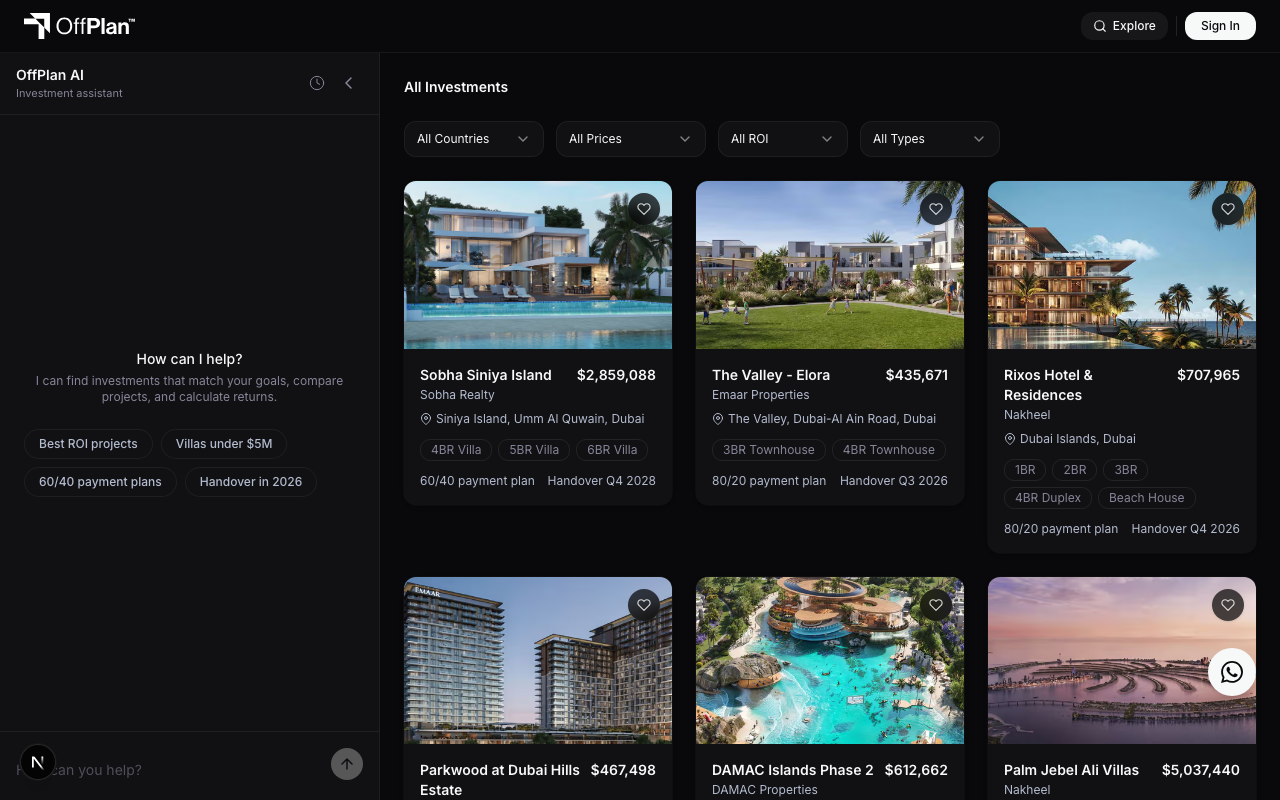
In suburban masterplans, the calculation is different. DAMAC Islands Phase 2 in Dubailand carries an estimated 8% ROI and a starting price of $612,662 for a four-bedroom townhouse, with handover in Q4 2029. That is a three-and-a-half-year construction window from today. Dubailand has matured significantly, but it remains infrastructure-dependent, and the lifestyle theme, however differentiated, does not conjure tenants who are not already moving to the corridor. The yield projection assumes occupancy that is plausible but not guaranteed at that horizon.
What DAMAC is definitively not known for: the kind of quiet, consistent delivery that earns institutional confidence. Emaar and Meraas carry a different kind of trust. DAMAC's is louder, less reliable, and often, when the product is right, worth more.
Investor Perspective: How the Math Actually Works
On platform, the two live DAMAC projects bracket the strategy cleanly.
Canal Heights 2 in Business Bay is the higher-conviction position. Business Bay's rental dynamics are well-established, the De Grisogono branding creates a defensible short-stay premium, and the Q2 2027 handover is eighteen months out, not five years. The 80/20 payment plan keeps capital light through construction. This is DAMAC working in its best environment: a liquid submarket, a brand co-signature that does real work, and a near-term window that compresses construction risk.
DAMAC Islands Phase 2 is a different proposition. The 8% ROI is the headline, and the early-stage pricing is genuinely competitive for a masterplan community with this amenity depth. But Q4 2029 is a long runway, and DAMAC's track record makes that runway feel longer than it looks on paper. Investors should assume a possible twelve-month delay and underwrite accordingly. The yield works if occupancy follows the lifestyle draw. If Dubailand's population growth stalls or infrastructure lags, it doesn't.
The pattern with DAMAC is consistent: buy where the brand is doing real work and the submarket is already liquid. Accept the delay risk with a cash buffer. Exit before the community matures fully, because DAMAC resale stock typically moves on narrative momentum, and that momentum is strongest in the early years after delivery.
The bottom line: DAMAC offers among the most accessible routes to branded yield in Dubai. The developer earns that premium but requires more patience, more stress-testing, and more exit planning than the headline returns suggest. Go in with eyes open to the delivery risk, and the 7 to 8% range is achievable. Go in expecting Emaar-level execution and you will be disappointed.
Data sourced from OffPlan. ROI projections are developer-estimated and not guaranteed. This is not financial advice.