Dubai's $40 Billion Pipeline: Which Districts Will See Oversupply by 2027
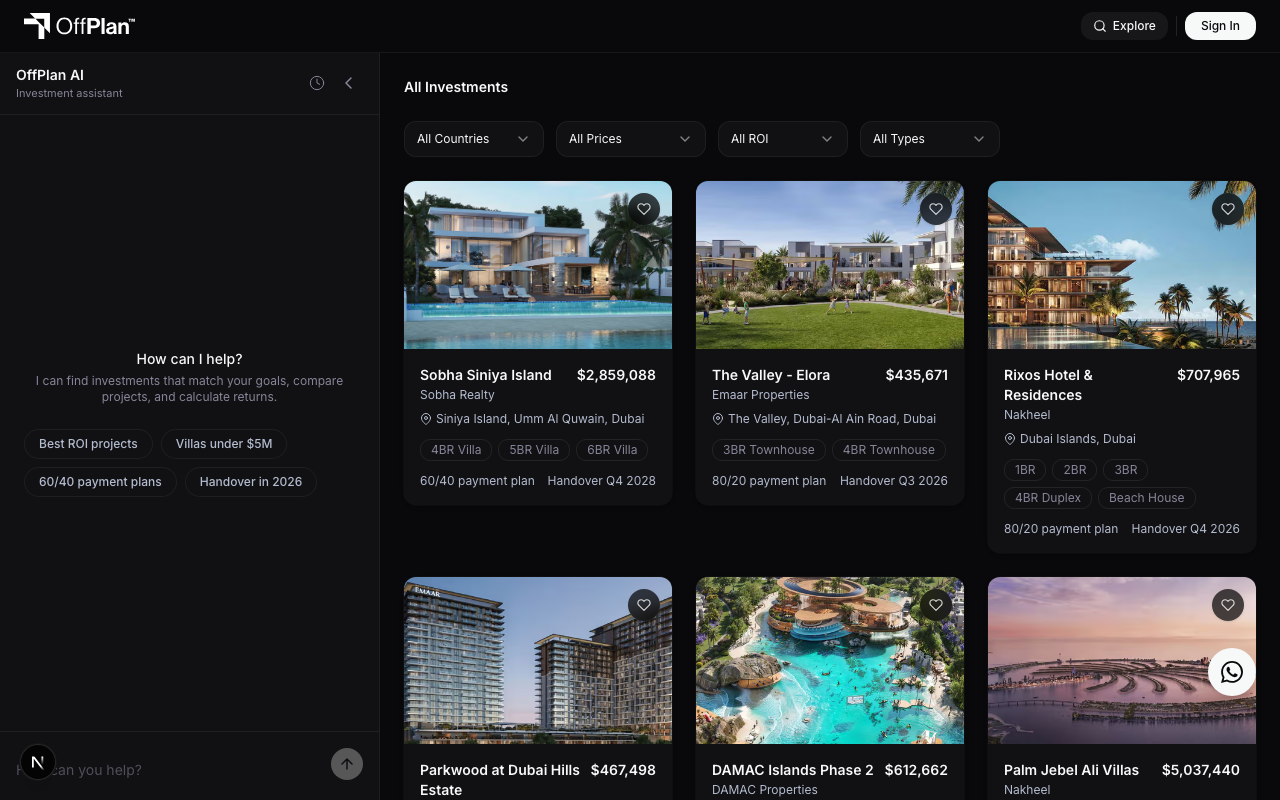
Launch activity in mid-market corridors drove the clustering effect.
Executive Summary
Dubai's development pipeline is the largest in its history, and not every district will absorb it equally. The risk is not citywide oversupply but hyperlocal saturation, concentrated in a handful of corridors where developers launched simultaneously into the same buyer demographic. Investors who treat Dubai as a monolith will be the ones caught holding inventory when handover season arrives.
The Dynamic
The mechanism worth understanding is not the volume of supply itself but the synchronisation of it. When multiple large developers launch in the same submarket within the same twelve-month window, their handover dates cluster two to three years later. That cluster creates a brief but brutal moment of simultaneous competition: hundreds of units entering the rental market at once, all chasing the same tenant pool, all at similar price points.
This is not hypothetical. It is the structural consequence of how off-plan development works. Launches feed on demand signals. Strong absorption in a district attracts the next developer, then the next. By the time the last one launches, the demand signal it read was already eighteen months stale. The units it sells today will complete into a market shaped by everything launched before it.
What Is Driving This (the Real Cause)
The obvious explanation is greed or poor planning. The real cause is the incentive structure of staged payment plans. Off-plan buyers commit to units with relatively small upfront payments, which means developers can pre-sell inventory before construction financing is fully secured. This compresses the risk signal. A district can appear to have robust demand simply because buyers are purchasing optionality, not committing capital in full. The true stress test comes at handover, when buyers must complete payment or sell. If the secondary market is thin because fifty competing units are available simultaneously, prices compress and some buyers walk.
The districts most exposed are those that attracted the heaviest launch activity in 2023 and 2024, particularly mid-market corridors positioned as affordable alternatives to established premium zones. These areas drew buyers precisely because entry prices were lower, but lower entry prices also mean the buyer base has less financial resilience and a higher propensity to exit at handover.
Established districts with genuine scarcity constraints, whether through geography, planning restrictions, or brand anchoring, face a structurally different dynamic. Supply cannot replicate itself infinitely when land is genuinely constrained.
What It Means for Investors
The bifurcation is already happening at the asset level, not just the district level. Within any given corridor, a well-specified unit in a project with a credible developer and a differentiated amenity set will hold its rental premium even in a crowded market. A commodity unit in the same postcode will not.
The practical implication is that oversupply risk in Dubai is largely a mid-market, high-volume-corridor problem. Premium waterfront locations, districts with genuine planning constraints, and branded or serviced product categories are insulated not because they are immune to supply cycles but because their buyer and tenant profiles are less interchangeable. A renter choosing a serviced residence or a premium waterfront apartment is not choosing between fifty identical options.
For investors entering now, the single most important question is not what the stated yield is today but how many comparable units will complete in the same twelve-month window as the project in question. That figure shapes everything from rental achievability to resale liquidity at handover.
What to Watch
| Signal | What it tells you |
|---|---|
| Launch-to-handover clustering in a submarket | Indicates future rental competition density |
| Buyer profile at launch | End-users absorb supply; investors create it |
| Payment plan completion rates | Stress indicator for secondary market at handover |
| Developer track record in that specific district | Delivery risk is not uniform across names |
| Land scarcity in the zone | Hard ceiling on future competing supply |
The 2027 handover window will separate districts that absorbed their pipelines from those that did not. The structural fault line runs between corridors built on genuine demand and those built on the momentum of a launch cycle that has already peaked. That distinction is knowable now. The investors who act on it will not be surprised.
Data sourced from OffPlan. ROI projections are developer-estimated and not guaranteed. This is not financial advice.