Nakheel: From Near-Bankruptcy to Building Dubai's Second Palm
Executive Summary
Nakheel is a government-backed developer that failed catastrophically in 2009 and was rebuilt through sovereign intervention. The crisis is real history, not a footnote. The post-restructuring track record is credible, and the current Palm Jebel Ali relaunch carries the full backing of Dubai Holding. For investors buying in today, the failure is priced into context, not into risk.
Track Record: Collapse, Recovery, Delivery
The numbers from 2009 were stark. Nakheel carried debt it could not service, the World islands sat unfinished in the Gulf, and Palm Deira was quietly abandoned. A government bailout of historic scale followed. For anyone who bought off-plan into Nakheel projects during the boom years, the experience ranged from painful delays to protracted compensation disputes. That is not sanitised history. It happened.
What happened next is the more relevant data set. Post-restructuring, Nakheel delivered. Discovery Gardens was completed. International City matured into one of Dubai's most consistently occupied residential communities. Palm Jumeirah became the most recognisable address in the Gulf, with Nakheel's frond villas now trading at premiums that would have seemed implausible in 2010. The developer also built and handed over the Palm Jumeirah Boardwalk, Nakheel Mall, and Ibn Battuta expansion, establishing a post-crisis delivery record that most private developers cannot match.
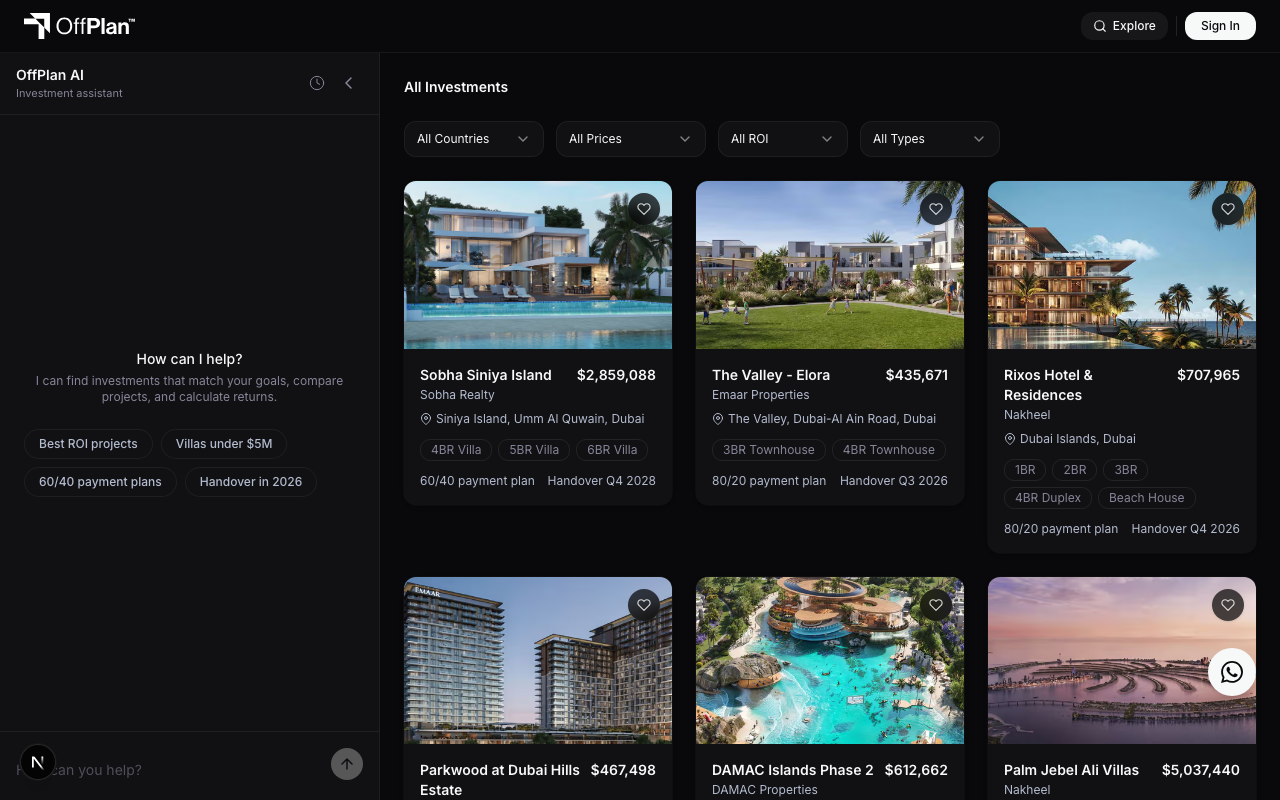
Dubai Islands, formerly Deira Islands, is the most instructive recent case. Repositioned, rebranded, and now delivering infrastructure, including an operational cruise terminal, with multiple hospitality projects underway. Rixos Hotel and Residences, which sits on Dubai Islands and is on the OffPlan platform with a Q4 2026 handover, represents exactly the kind of branded, income-generating product Nakheel now brings to market.
What They Are Known For: Scale, Ambition, and the Government Backstop
Nakheel's core identity is engineering things that should not exist: man-made palm islands, an archipelago shaped like a world map, a waterfront retail corridor in the desert. That instinct for spectacle is not purely cosmetic. Scarcity is real when the asset is a private-beach villa on a frond that physically cannot be replicated.
The negatives are equally structural. Nakheel operates on timelines that reflect the complexity of what it builds. Buyers accustomed to Emaar's relatively disciplined delivery cadence will find Nakheel's calendar less predictable. Palm Jebel Ali sat dormant for nearly two decades before the 2023 relaunch. The Q4 2028 handover date on the current villa collection is ambitious for a project of this infrastructure intensity, and investors should underwrite some probability of a modest delay without treating it as a catastrophe.
Service charges across Nakheel communities run higher than comparable mainland developments, reflecting the cost of island and waterfront maintenance. This is a known overhead, not a surprise, but it compresses net yield and should be modelled before committing.
Investor Perspective: What Buying Nakheel Actually Means
Palm Jebel Ali villas start at $5,037,440 for a five-bedroom with private beach access, on an 80/20 plan with the final 20 percent due at Q4 2028 handover. That payment structure means approximately $4 million is committed during the construction window. The stated estimated return is 6 percent, which at this price point translates to meaningful absolute income, but the exit multiple is the more compelling thesis. There is nothing comparable being developed in Dubai, and the sovereign backing removes the existential delivery risk that plagued Nakheel's pre-crisis projects.
The government backstop is the underwriting argument. Dubai Holding's full involvement in the Palm Jebel Ali relaunch means this is not a developer gambling with its own balance sheet. It is a state asset being developed on a state timeline for strategic reasons that extend well beyond individual project economics. That changes the risk profile materially. Nakheel in 2009 was a private developer with unsustainable leverage. Nakheel today is effectively an arm of Dubai's sovereign development apparatus.
The honest investor framing is this: you are buying an irreplaceable waterfront position on a government-backed island, from a developer whose failure is a matter of public record and whose recovery is equally well documented. The floor risk is lower than the history suggests. The return depends on how long you can hold, and whether Dubai's ultra-luxury demand absorbs what is, ultimately, a very limited supply of an asset class that does not exist anywhere else.
For investors who need liquidity within three years, this is the wrong product. For those who can hold through the construction period and into a functioning island, the scarcity argument is structurally sound.
Data sourced from OffPlan. ROI projections are developer-estimated and not guaranteed. This is not financial advice.