Off-Plan Property Investment: The Complete Definition for US Investors
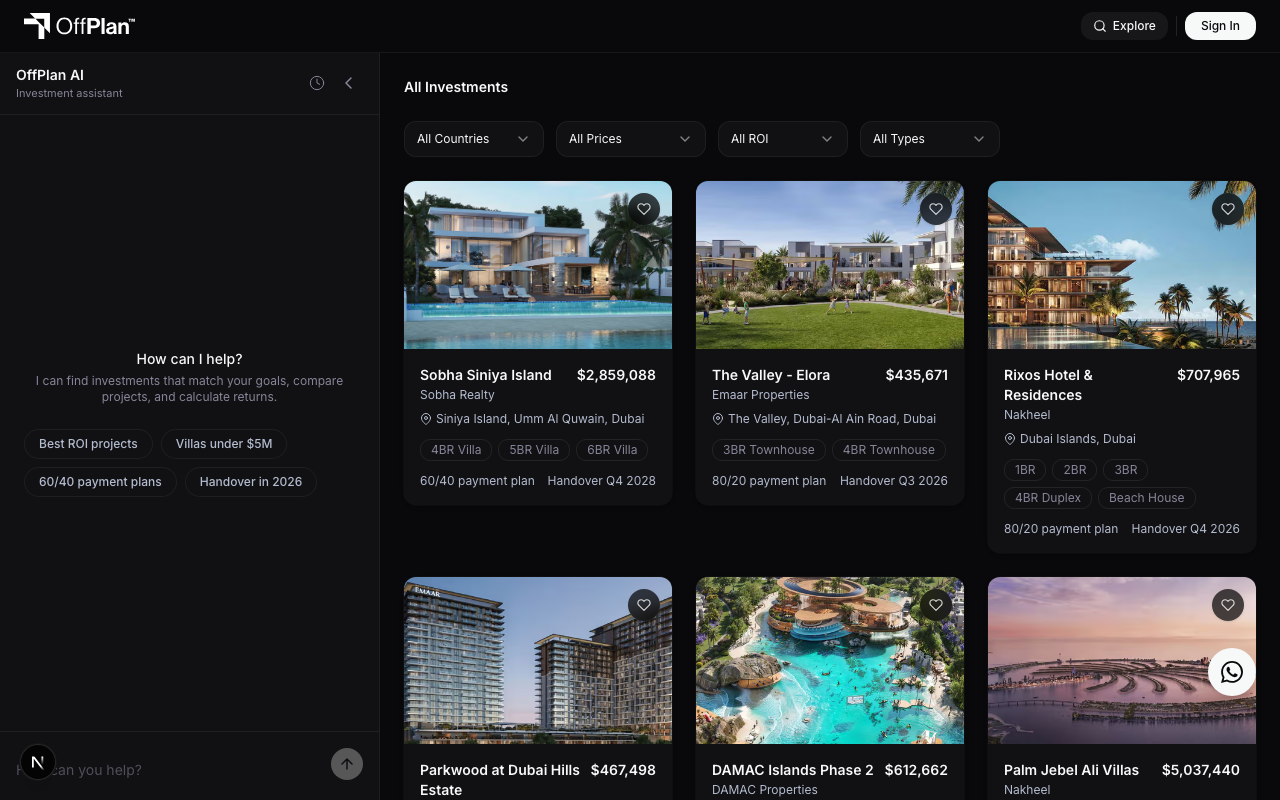
Typical off-plan payment structure: 20% upfront, balance staged.
Executive Summary
Off-plan means you contract to buy a property before construction is complete, typically paying in stages as the building rises. The core logic is simple: developers sell early at a discount to fund construction, and investors capture the price difference between contract day and handover. The risk is real but bounded, and knowing how the structure works is what separates informed capital from optimistic hope.
What It Actually Means
In the US, buying real estate usually means a property exists, you inspect it, and you close. Off-plan inverts this. You are buying a promise, backed by a contract, a developer's reputation, and in well-regulated markets, some form of escrow protection.
The appeal is pricing. Developers in international markets, from Dubai to Athens to Phuket, routinely price early-phase units below what they expect to charge at completion. They need cash flow to begin construction. You need access to a market before it re-rates. That mutual need is the foundation of the trade.
The real-world implication for a US investor is this: you are not inspecting a finished apartment. You are underwriting a development company, a legal framework, a location, and a payment timeline. It is a different skill set from buying a condo in Miami, but it is a learnable one.
How It Works in Practice
Say a developer launches a project in a freehold zone, with units priced at $300,000. The payment plan runs like this: 20% on signing, then installments tied to construction milestones, with the remaining balance on handover in late 2028.
Your total cash outlay before handover, in this hypothetical, might be $120,000. The unit's market value by completion, if the location has matured and the developer delivered on time, could sit above the contract price. That gap is your capital gain, unrealised until you sell or rent. Meanwhile you have not deployed the full $300,000 for the two-year construction period.
This is the mechanic that makes off-plan structurally interesting: staged payments mean your capital is not fully committed upfront, and you are earning exposure to a completed asset while it is still being built.
| Scenario | What Happens | Investor Outcome |
|---|---|---|
| Developer delivers on time, market rises | Unit worth more than contract price at handover | Capital gain, or strong rental yield from day one |
| Developer delays by 6-12 months | Unit completes late, cash flow delayed | Inconvenient, rarely catastrophic if project completes |
| Developer fails mid-construction | Project stalls or is cancelled | Escrow-protected markets return deposits; others may not |
| Market softens at handover | Unit worth less than contract price | You bought an asset, not a liquid position; rent and wait |
These scenarios are illustrative. Outcomes depend on jurisdiction, developer, and contract terms.
What to Look For
Before signing anything, four things matter more than the renders:
- Escrow regulation. In the UAE, developer payments are held in regulated escrow accounts tied to construction progress. In other markets, protections vary. Know exactly where your money sits.
- Developer track record. How many projects has this company completed? Delivered on time? Delivered to the spec promised? A developer who has completed five projects is not the same risk as one on their first.
- Tenure clarity. Freehold means you own the asset outright. Leasehold means you own the right to occupy for a fixed term. This distinction matters enormously for resale value and long-term hold strategy. Thailand and the Maldives, for example, typically offer foreigners leasehold on villas and houses.
- Exit mechanics. Can you resell during construction? Some markets allow assignment of contract before handover. Others do not. If your strategy involves flipping before completion, check this before you buy.
Common Mistakes
The most common error is treating the developer's projected rental yield as guaranteed income. It is a marketing assumption, not a contract. Model your own numbers.
The second is ignoring currency risk. You are earning or spending in dirhams, euros, or baht. A US investor who made a strong paper gain can see it eroded by exchange rates at repatriation.
The third, and most costly, is skipping legal due diligence because the purchase price feels low. A $150,000 apartment in a weak regulatory environment can become a $150,000 lesson. In jurisdictions with strong foreign-ownership frameworks, this risk shrinks considerably. Knowing which markets offer that protection is the starting point for doing this well.
Data sourced from OffPlan. ROI projections are developer-estimated and not guaranteed. This is not financial advice.