Palm Jebel Ali vs Palm Jumeirah: Which Palm Delivers Better Returns?
Executive Summary
Palm Jumeirah is a mature, liquid market where returns are driven by rental income today. Palm Jebel Ali is an appreciation play on a government-backed island that does not yet exist as a functioning community. For investors who need yield, Palm Jumeirah wins. For those with capital, patience, and a high-net-worth horizon, Palm Jebel Ali is the more interesting long-term bet. Pick your holding period before you pick your palm.
Palm Jumeirah: The Case for the Known Quantity
Palm Jumeirah is one of the most recognizable addresses in the world, and that recognition translates directly into rental demand. The frond villas, the crescent apartments, the beachfront hotels: all operational, all tenanted, all liquid in the secondary market. When you buy here, you are not underwriting an idea. You are buying into a submarket that has already been stress-tested by a decade of actual occupancy.
The live listing here is Maison Margiela Residences on the East Crescent: 25 apartments only, handover Q1 2028, starting at $4,490,000. This is branded ultra-luxury at the sharper end of the Palm Jumeirah spectrum. No estimated ROI is published, which is honest. At this price point and with this scarcity, the investment case is not about yield compression. It is about capital preservation, exclusivity premium, and the fact that a building with 25 units and Maison Margiela's name on it does not compete on rental volume. It competes on renter profile.
The broader Palm Jumeirah market, however, does generate yield. Short-term rental demand is structurally embedded here. The infrastructure, beach access, hotel corridor, and Atlantis draw a global pool of renters year-round. Branded residences on established addresses command measurable rental premiums over unbranded stock. The trade-off is entry price: Palm Jumeirah is expensive because it already works, and that is priced in.
Liquidity is the other advantage. Resale volume on Palm Jumeirah is consistent. If circumstances change, you can exit. That optionality has real value.
Palm Jebel Ali: The Case for the Blank Canvas
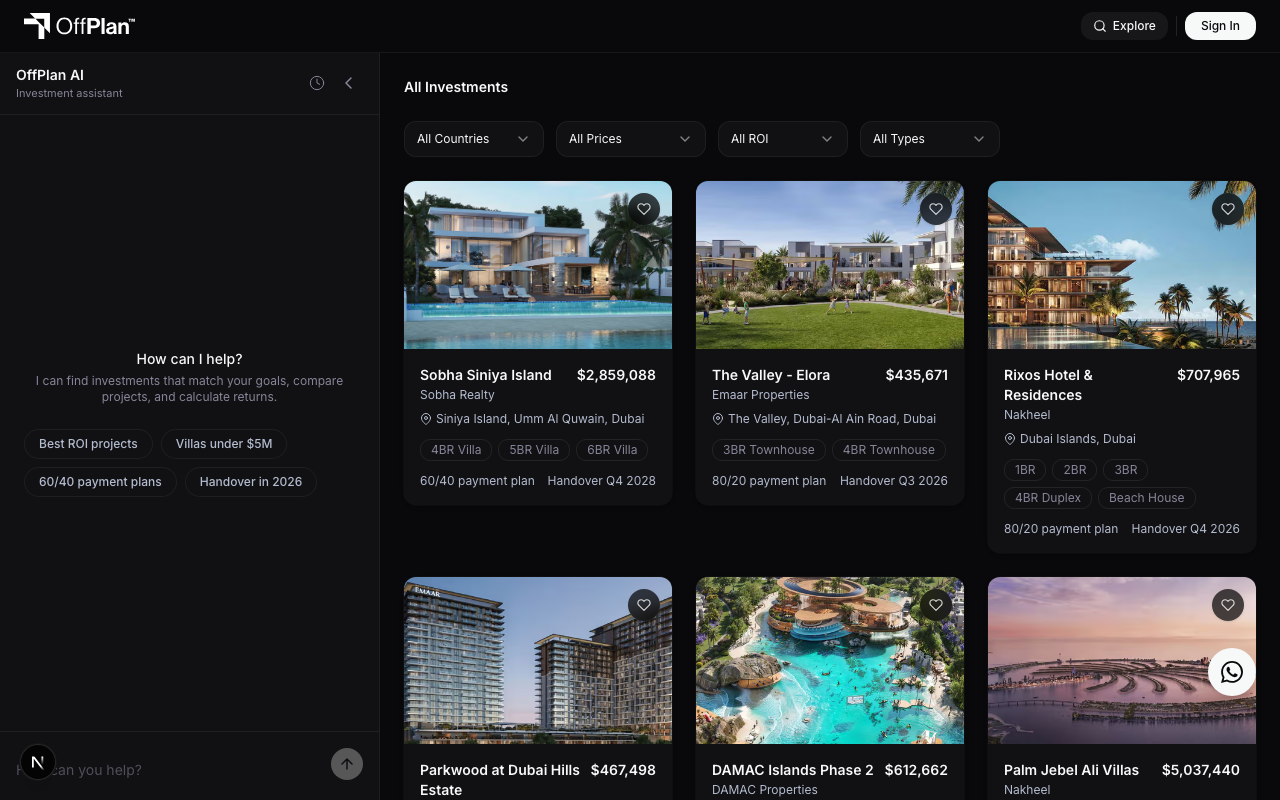
Palm Jebel Ali is a different kind of bet entirely. The live listing here is Palm Jebel Ali Villas by Nakheel: 5 and 6-bedroom villas with private beach access, starting at $5,037,440, handover Q4 2028, on an 80/20 payment plan. Estimated ROI is published at 6%, which is the developer's projection for a community that does not yet have tenants, comparable rentals, or operational infrastructure to verify against.
The investment thesis is structural scarcity backed by sovereign capital. Dubai Holding relaunched this island after nearly two decades dormant. The government does not do that without a plan. A 5-star hotel, yacht club, and marina village are planned within the masterplan. No comparable supply exists or is being built. When this island delivers, it will be the only second-frond-and-beach-access address in Dubai at this scale.
The payment plan is disciplined: 80% due during construction, with the final 20% at Q4 2028 handover. That means a buyer at the starting price commits approximately $4,029,952 before keys. The construction window to Q4 2028 is the risk period. Nakheel is government-backed, so developer risk is lower than average, but the island's amenity buildout will take years beyond the residential handover. Early buyers are not moving into a finished resort. They are moving into a villa on an island that is still becoming one.
The 6% ROI stated is also a softer number than Palm Jumeirah equivalents, reflecting that the rental market here is nascent. In practice, early-phase rental income may underperform that figure until the hotel and marina are operational and the island has a tenant track record.
Head-to-Head: The Metrics That Matter
Entry price and yield: Palm Jebel Ali starts at $5,037,440 with a projected 6% ROI. Palm Jumeirah's Margiela listing starts at $4,490,000 with no published ROI, but the wider Palm Jumeirah market has a demonstrably functioning rental ecosystem behind it. On income generation today, Palm Jumeirah has the structural edge.
Appreciation potential: Palm Jebel Ali holds the stronger scarcity argument. A new island with government backing and no competing supply pipeline is the kind of asset that, if the macro holds, appreciates as the community matures. Palm Jumeirah's upside is more incremental from here.
Liquidity: Palm Jumeirah by a wide margin. Secondary market depth on Palm Jebel Ali will not develop until the island has a functioning population. If you need to exit before that, the buyer pool is thin.
Construction risk: Both carry off-plan risk. Nakheel's sovereign backing reduces it meaningfully on Palm Jebel Ali. The Q4 2028 handover is 2.5 years away. That is a real window.
The Verdict
Buy Palm Jumeirah if you are an income investor with a 3 to 5-year horizon who needs the rental machine to work from day one. The infrastructure is in place, the demand is proven, and the exit is cleaner.
Buy Palm Jebel Ali if you are a capital-allocator with a 7 to 10-year view, genuine comfort with illiquidity during the buildout phase, and a conviction bet on Dubai's long-term trajectory. The scarcity here is real. So is the wait.
For most investors reading this, Palm Jumeirah is the better decision. The returns are lower on paper but more reliable in practice, and the liquidity premium is worth more than most buyers account for. Palm Jebel Ali is compelling. It is just not ready yet.
Data sourced from OffPlan. ROI projections are developer-estimated and not guaranteed. This is not financial advice.