Six Senses Residences Comporta: The Investment Case
Executive Summary
Six Senses Residences Comporta is a capital-preservation and lifestyle play on one of Western Europe's most supply-constrained coastal corridors, not an income vehicle. No ROI is stated because rental yield is not the primary return mechanism here. Buyers are acquiring a branded asset within a genuinely irreplaceable protected landholding, with the bet that scarcity, brand, and European demand for high-wellness rural retreats will hold or grow its value over time.
There are 58 residences on this estate. That number is not incidental. It is the entire investment thesis, compressed into a single constraint.
The Numbers
Entry starts at $2.76 million for a two-bedroom. The five-bedroom villas will sit materially above that. Without unit sizes disclosed, precise price-per-square-metre cannot be derived, but the starting price positions this firmly in the upper tier of Portugal's residential market.
The payment plan is staged against construction milestones, which is standard for off-plan in this market. This means capital is deployed in tranches rather than upfront, preserving liquidity across the construction window to June 2028. That is a two-year exposure period from today. For a buyer committing at the lower end, expect to have deployed the bulk of the purchase price in roughly six to eight milestone payments between now and handover.
There is no stated ROI, and that honesty is worth something. Branded residence developments in secluded natural settings typically generate more modest yields than urban short-term rental product. The service charge associated with Six Senses management will be non-trivial. Buyers who run this expecting Dubai-style gross yields will be disappointed and should not buy it.
What Makes It Interesting
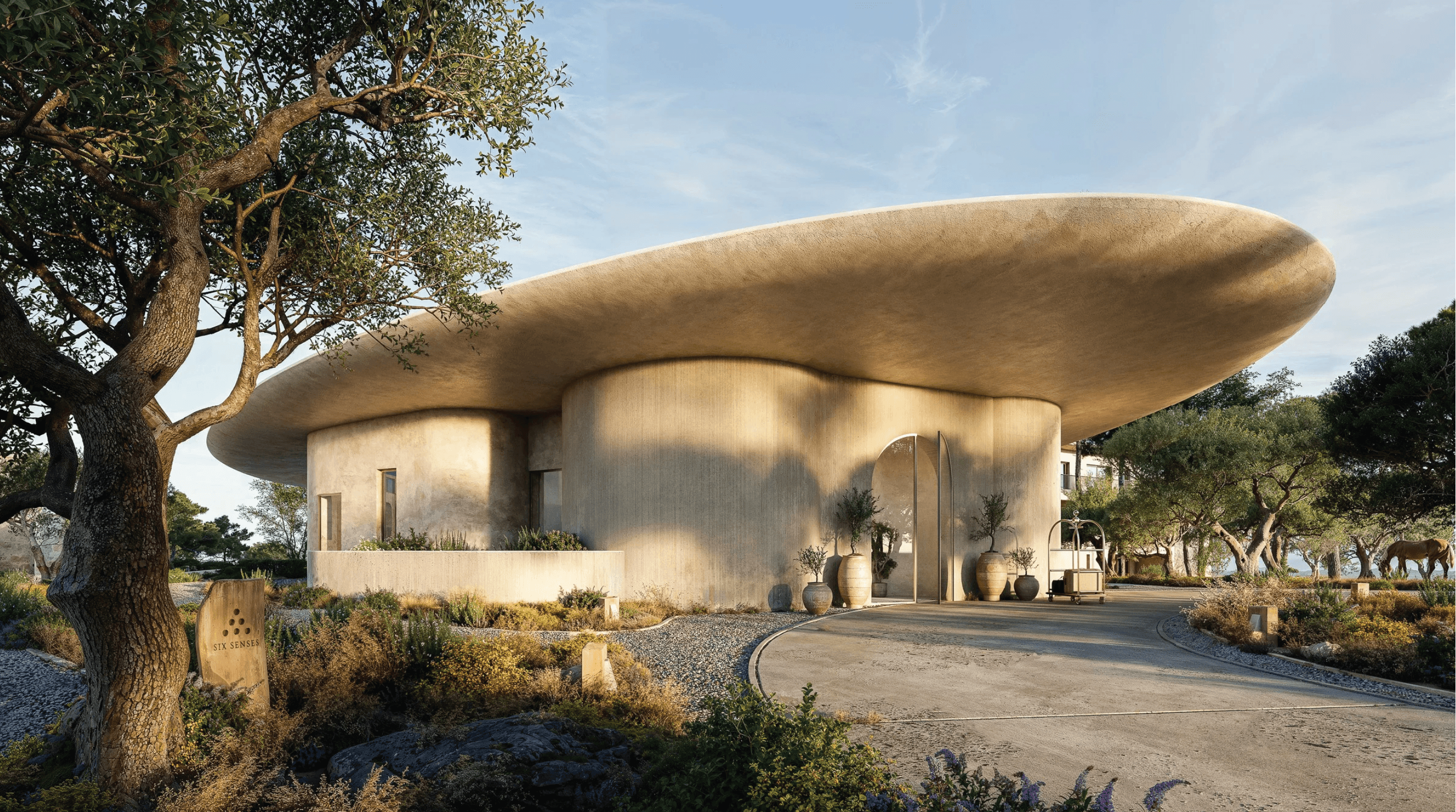
The first differentiator is the landholding itself. Herdade do Pinheirinho is a 400-hectare protected pine forest and dune estate. In Portugal's Setúbal Natural Park corridor, the planning environment is among the most restrictive in Europe. Nothing comparable is being built on adjacent land. This is not a slogan. It is a legal reality. The supply cap is structural and permanent.
The second differentiator is brand positioning within that constraint. Six Senses has built a genuinely credible global reputation in the high-wellness resort category, which is among the fastest-growing segments of international luxury travel and second-home demand. Branded residences in operating resort environments with a genuine wellness programme, golf, spa, and beach access attached tend to hold resale premiums over generic luxury product. The mechanism is the same as other branded-residence markets: the management infrastructure, the name, and the access are bundled into the asset.
Michaelis Boyd's architecture, organised around Sand, Forest, and Lake biome palettes rather than a single generic luxury finish, gives individual character to different parts of the estate. In a resale market, that differentiation matters.
What to Watch
Construction risk is real. Handover is June 2028, the project is under construction, and VIC Properties, while a credible Portuguese developer, does not carry the delivery track record of an Emaar or Nakheel. Portugal's construction sector has experienced cost and timeline pressure. Buyers should understand their legal recourse under Portuguese off-plan purchase contracts and ensure a local lawyer has reviewed the promissory agreement before committing.
Liquidity is the more fundamental concern. With 58 units in a protected rural location one hour from Lisbon, the resale pool is narrow. This is not a market where you exit quickly if circumstances change. The Comporta Coast attracts a specific, high-net-worth, predominantly European buyer. In a risk-off environment, that pool contracts sharply.
The Six Senses management cost will reduce net income if owners choose to rent. Short-season dynamics on the Comporta Coast, where peak demand concentrates in summer months, mean that annual occupancy assumptions should be conservative. Buyers building a financial model on aggressive short-let projections should revise them downward.
Portugal's Golden Visa programme has evolved and restrictions on coastal residential investment have been introduced in recent years. Buyers seeking residency-by-investment outcomes should take independent legal advice on current eligibility before treating this purchase as a visa pathway.
Bottom Line
This is for a specific buyer: European or internationally mobile capital seeking a genuine trophy asset in a supply-constrained natural environment, with a preference for capital preservation over yield, and a holding horizon of five to ten years minimum. The Six Senses brand, the scale of the estate, and the planning irreplaceability create a defensible long-term position.
Pass if you need income from day one, require a liquid exit, have concerns about construction-stage exposure to a single developer, or are buying primarily for a visa.
Data sourced from OffPlan. ROI projections are developer-estimated and not guaranteed. This is not financial advice.