The Real Risks of Off-Plan Property (and How to Reduce Them)
Off-plan property has a reputation for risk, and the reputation is earned. You are buying something that does not physically exist yet, on the strength of a plan, a render, and a developer's promise. Search "is off-plan risky" and you will find the same list every time: developers can go insolvent, projects get delayed, values can move before completion, and legal protection varies wildly from one country to the next.
All of that is true. None of it is the whole story.
The risks people list are real, but they are not evenly distributed. They fall hardest on the investor who goes it alone: who finds a single project, researches a single developer on that developer's own marketing, and reconstructs the entire due-diligence process from scratch. The same risks look very different when you approach them the way experienced investors actually do.
The biggest risk is doing it alone
Here is the reframe that matters. Off-plan risk is largely a function of information and process. The individual buyer negotiating directly with one developer has the least of both. They see one project, one price, one set of promises, and they have to verify everything themselves, usually for the first time.
The way to reduce that risk is not to avoid off-plan. It is to stop doing it alone. Below is each of the classic risks, and what actually changes when you approach it with verification and comparison rather than optimism.
Developer insolvency
The concern is straightforward: a developer can run out of money mid-build, and a half-finished tower is worth far less than the contract you signed. Going direct, you are researching one developer in isolation, and most of what you can find is their own marketing.
What reduces it: judging a developer across their whole record, not one brochure. A developer's active pipeline, their delivery history, and whether previous projects handed over on time tell you far more than a glossy render. Seeing that history in one place, next to comparable developers, turns "trust me" into evidence.
Construction delays
Projects slip. A handover that moves from 2027 to 2029 changes your return timeline and can complicate financing. The brochure will always show the optimistic date.
What reduces it: taking handover dates from the developer directly, and weighing them against that developer's actual delivery track record rather than their marketing. A developer who has delivered five projects on schedule is a different proposition from one launching their first, even if both promise the same quarter.
Legal protection and escrow
This is the risk most buyers underestimate. Off-plan funds are only as safe as the escrow arrangements and legal framework behind them, and those vary enormously by country. In some markets your deposit sits in a government-regulated escrow account and is released to the developer only as construction milestones are met. In others, protections are thinner.
What reduces it: only buying in markets with established off-plan legal frameworks and buyer protection, and knowing the structure before you commit. In Dubai, for example, RERA-regulated escrow ties developer access to your money to verified construction progress. Every serious off-plan purchase should also have its Sales and Purchase Agreement reviewed by qualified local legal counsel. That part never goes away.
Market and resale risk
Values can move between reservation and completion, and a single sales pitch tells you nothing about whether a project is priced well relative to its alternatives.
What reduces it: comparison. When you can see a project's price per square metre, its projected yield, and its payment plan next to genuinely comparable projects across several markets, you are sizing market risk with data instead of a salesperson's confidence. ROI figures should always be treated as estimates, projected from comparable rental yields, not guarantees.
The due-diligence burden
Every risk above requires work to manage: verifying the developer, reading the legal structure, comparing prices, checking track records. Done alone, for one project at a time, that work is enormous, and most buyers do not have the time or the reference points to do it well.
This is the real argument for a platform. It does not remove the risks of off-plan. It standardizes the process of managing them, so you inherit due diligence that has already been done and compared, rather than rebuilding it yourself.
Going direct versus joining a path already walked
Put the two approaches side by side.
Going direct, alone, you research one developer on their own marketing, take handover dates from a brochure, verify escrow and legal protection yourself, have nothing to compare the project against, and repeat all of it from scratch for the next project.
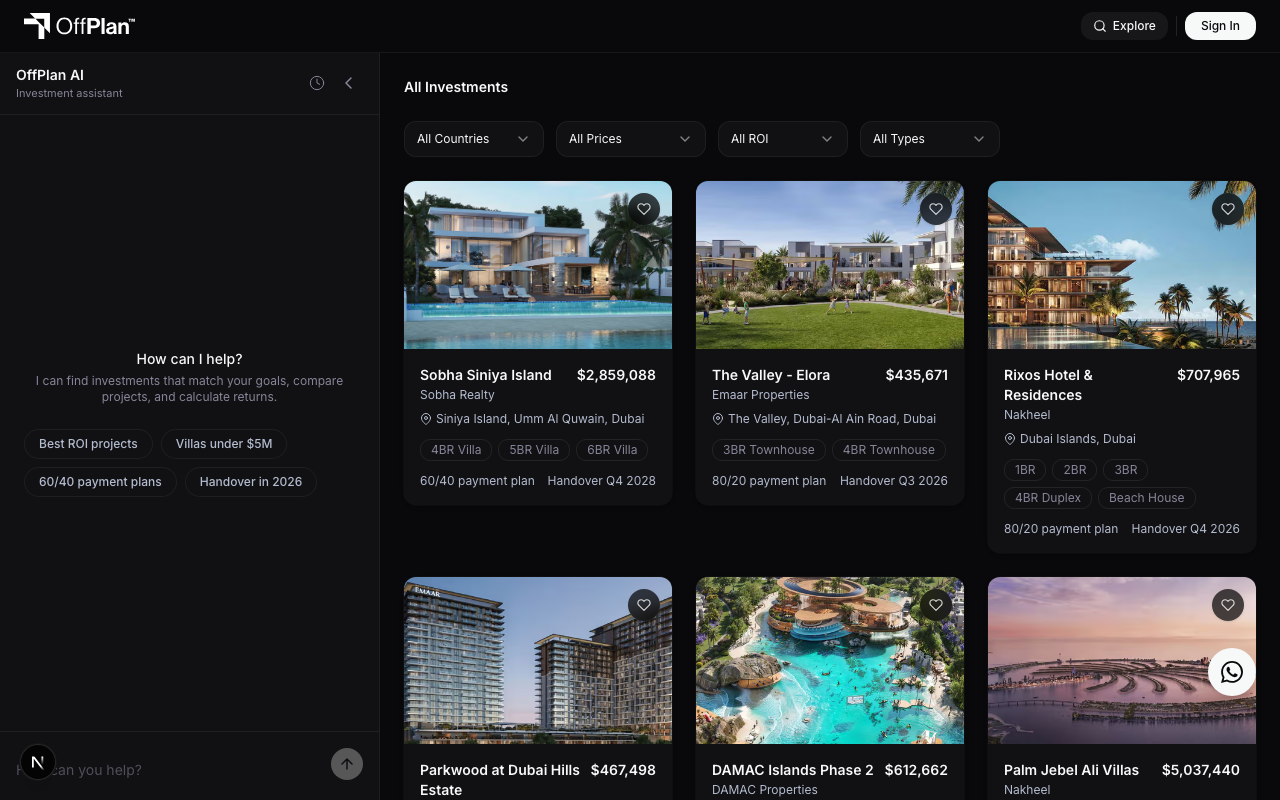
Through a verification-and-comparison platform, developers are reviewed for track record before a project is ever listed, handover dates and pricing come directly from developers, only markets with real buyer protection are covered, every project is comparable on ROI, price, and payment plan, and the due-diligence process is one you join rather than reconstruct.
The risks are the same in both cases. The exposure is not.
The honest version
It is worth being clear about what a platform can and cannot do. It can reduce information and process risk substantially: better developer selection, verified data, real comparison, established legal frameworks. It cannot eliminate market risk, and it is not a substitute for your own legal review of the contract you sign. Anyone telling you off-plan is risk-free is selling, not advising.
The point is not that off-plan is safe. The point is that the risks people cite are, to a large degree, the risks of walking the path alone. Joining a path already walked by thousands of investors, with the due diligence standardized and the developers vetted, is simply a better way to take on the same opportunity.
Data sourced from OffPlan. ROI projections are developer-estimated and not guaranteed. This is not financial advice.