The Valley vs Dubai Hills Estate: Emaar's Two Family Communities Compared

Executive Summary
Parkwood at Dubai Hills Estate costs more, hands over later, and delivers into one of Dubai's most proven rental and resale markets. The Valley Elora costs less, hands over in Q3 2026, and carries a higher-risk location argument offset by a better entry price. For investors who need the market to validate their choice, Dubai Hills wins. For investors who have done the math and can wait, Elora is the better-structured bet right now.
The Two Projects
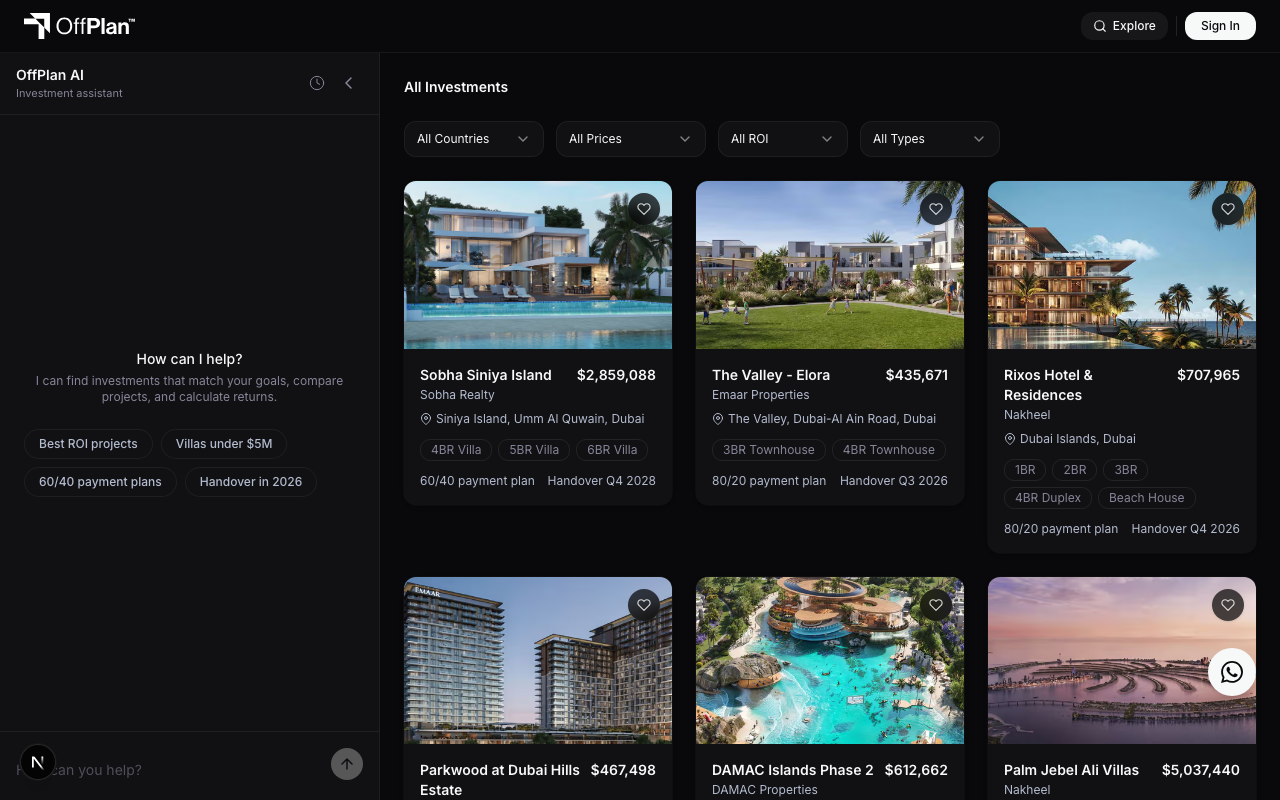
Elora at The Valley offers 3BR and 4BR townhouses starting at $435,671, sizing from 195 to 242 sqm, on an 80/20 payment plan with handover in Q3 2026. The developer's stated ROI is 7%. The masterplan includes a 30,000 sqm water park, sports village, and cycling infrastructure. Location is Dubai-Al Ain Road, roughly 25 minutes from Downtown.
Parkwood at Dubai Hills Estate offers 1 to 3BR apartments and 3BR townhouses starting at $467,498, sizing from 68 to 359 sqm, on an 80/20 plan with handover in Q1 2029. Stated ROI is also 7%. The community plugs directly into Dubai Hills' operational infrastructure: the mall, schools, hospital, and 18-hole golf course are already running. GEMS Wellington Academy sits 1 km away.
On Their Own Terms
Elora's argument is efficiency. At the 3BR townhouse level, you are acquiring private garden space at a price point that is genuinely difficult to replicate in operational Emaar communities. The construction risk is nearly resolved: with a Q3 2026 handover, the project is in its final stretch. Investors buying now are not underwriting three years of development uncertainty; they are weeks away from completion. The 80/20 structure means the final 20% lands at handover, converting paper gains into a rentable asset in the near term. The trade-off is honest: The Valley remains a developing submarket. Schools, retail, and the surrounding road network are maturing, not mature. Tenant demand exists in the family rental bracket, but it is thinner than in established communities and more sensitive to amenity gaps.
Parkwood's argument is liquidity and institutional confidence. Dubai Hills Estate is not a promise; it is an operating community with verifiable rental demand, consistent resale velocity, and tenant profiles that run deep. Vida-branded interiors are not cosmetic. They push achievable rents above the generic apartment baseline. The Q1 2029 handover is the honest weakness: two and a half years of construction exposure on a completed-community premium. The entry price is not steep, but you are paying Dubai Hills pricing to wait.
Head-to-Head on the Metrics That Matter
Price and value density. Elora wins. More square metres, private gardens, and a lower absolute entry for a family product. Parkwood's starting price buys a one-bedroom apartment, which is a different asset class to a townhouse with a garden.
Construction risk. Elora wins, and it is not close. Q3 2026 handover versus Q1 2029. Elora buyers are essentially done waiting. Parkwood buyers are at the beginning of a hold period with no rental income and continued capital calls.
Rental market depth. Parkwood wins. Dubai Hills has an established, deep tenant pool anchored by proximity to DIFC employment, operational schools, and the mall. The Valley's family rental market is growing but has less proven demand volume.
Resale liquidity. Parkwood wins. Dubai Hills trades at consistent volume with institutional buyer interest. The Valley is earlier in its liquidity cycle and carries more location-specific risk on exit.
Yield potential. Both are quoted at 7%. Elora's case is that its lower entry price gives the yield a stronger foundation: the same rental income on a smaller denominator. Parkwood's case is that tenant demand supports stronger absolute rents. They are roughly equal in expectation, but Elora gets there sooner.
The Verdict
Buy Elora. The investment case is cleaner for most buyers at this moment. Construction risk is negligible. The price-per-square-metre is compelling for a townhouse with private outdoor space. And the 7% yield on a Q3 2026 asset means cash flow starts in months, not years.
Parkwood is not a bad choice. It is the right choice for a specific buyer: someone who wants passive Dubai Hills exposure without navigating the resale market, who has no urgency on cash flow, and whose timeline comfortably extends to Q1 2029. That investor exists. But for the majority of buyers weighing these two projects today, paying more to wait longer for a smaller unit is the wrong direction.
Data sourced from OffPlan. ROI projections are developer-estimated and not guaranteed. This is not financial advice.