Muraba Veil: The Investment Case for the World's Thinnest Tower
Executive Summary
Muraba Veil is not a yield play. It is a scarcity argument: 131 apartments in a structurally unrepeatable building, designed by a Pritzker laureate, in a freehold Dubai market where architectural provenance is increasingly priced into resale. The investment thesis rests on capital appreciation and the premium this building will command at exit, not on rental income optimisation. Investors who need a yield figure to commit should pass.
The Numbers
The entry point is $4,820,000, and the payment plan is unusually back-loaded: 50% is due on handover at Q4 2028. That structure is the first thing to examine.
For a buyer at the starting price, roughly $2,410,000 is deployed during the construction phase, with the balance due in late 2028. The construction-risk window runs approximately two and a half years. On a $4.82 million entry, you are committing half your capital now and half at the moment the asset becomes income-producing or saleable. That is a meaningful capital efficiency argument. It also means the total cash call at handover is significant and non-negotiable, so buyers need to plan liquidity accordingly.
No ROI figure is stated, and none is derived here. What can be derived: a two-bedroom unit in this segment of Al Wasl, adjacent to the Dubai Water Canal, in a building with one apartment per floor and private elevators per residence, occupies territory where ultra-prime tenants expect to pay for the exceptional. The building's architecture creates a defensible premium. But Muraba Veil is not a short-term rental product, and it is not a high-turnover yield asset. Buyers targeting sub-two-year holds or double-digit gross yields are misreading the product.
What Makes It Interesting
Two things, genuinely.
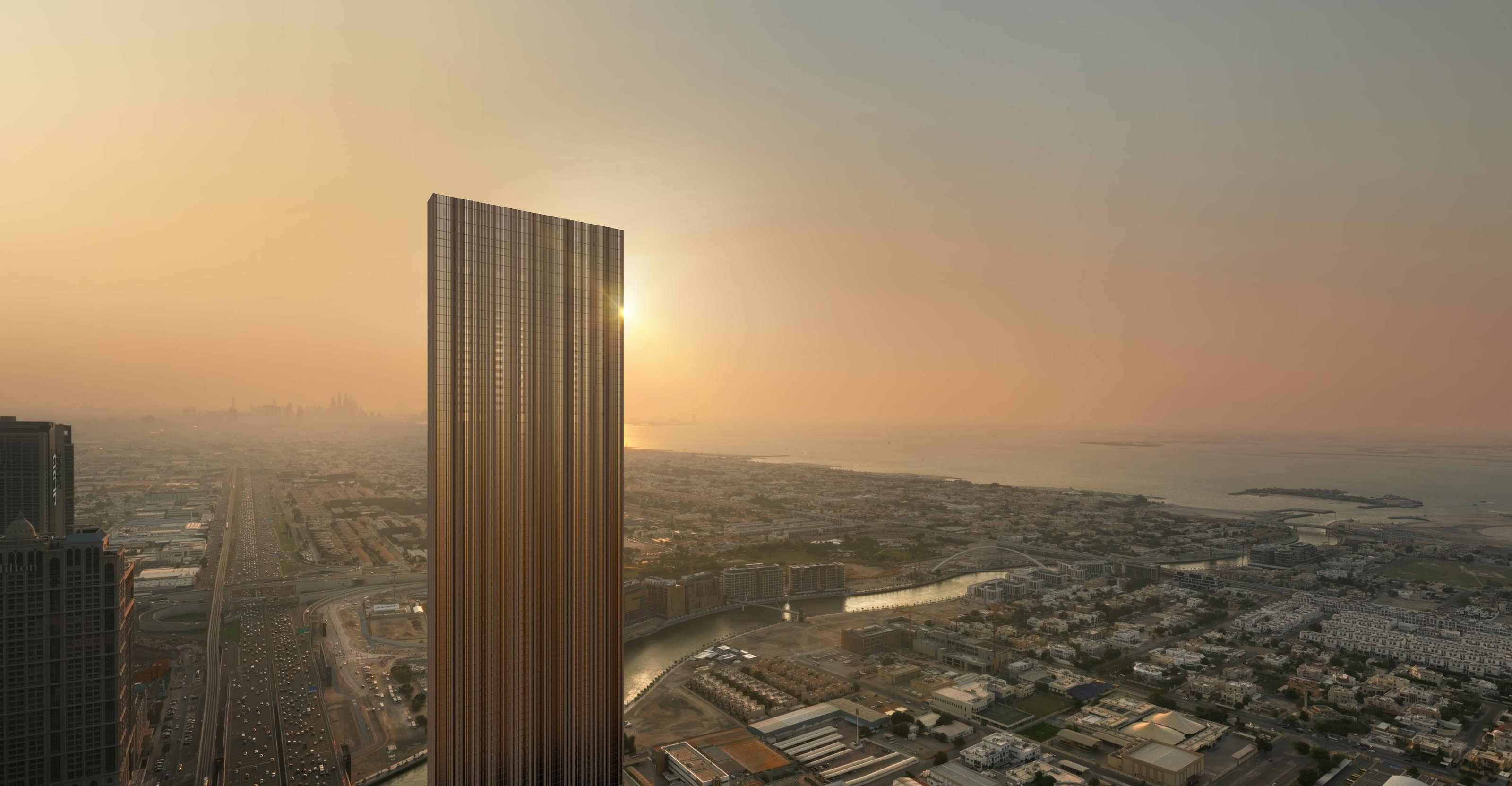
First, the structural impossibility. A 17:1 slenderness ratio, engineered by WSP and Arup, producing a building 380 metres tall and 22.5 metres wide. One apartment across, every floor, from the second storey to the seventy-third. Dual-aspect terraces on both faces create through-building cross-ventilation in a city that runs air conditioning from June through September. The gold stainless steel mashrabiya is not decorative cladding. It is a functioning passive shading and ventilation system at building scale. No other tower in Dubai works this way. More importantly, none can. The engineering conditions that make this possible are as rare as the aesthetic.
Second, RCR Arquitectes. The Barcelona studio won the Pritzker Prize in 2017 for buildings that refuse spectacle in favour of precision. Muraba and RCR have worked together for a decade. This is the most ambitious expression of that partnership, and it is the kind of building that enters architectural history rather than the rental listings. Assets with that status trade differently at resale. The comparable is not another Dubai tower. It is a Zaha Hadid building, or a Peter Zumthor house: work that commands its own market.
The Al Wasl location compounds both arguments. Adjacent to the Dubai Water Canal, walkable to Jumeirah Beach and Safa Park, in a part of the city that attracts the category of resident this building is designed for.
What to Watch
Muraba Properties is a boutique developer, not a volume builder. That is the source of the product's distinctiveness and the source of its primary risk. Smaller developers carry more delivery uncertainty than Emaar or Nakheel, regardless of intention. The Q4 2028 handover is the date to hold against, and buyers should track construction progress actively.
The back-loaded payment plan also creates a specific exposure: if Dubai's ultra-prime market softens between now and late 2028, the second 50% payment lands into a weaker resale environment. The building's scarcity protects against that scenario better than most products in this price band, but it does not eliminate it. Liquidity in this segment is thinner than in the volume market by definition.
A third watch item is straightforward: 131 units, no rental pool, no hotel management. Income generation requires active management or a reliable agent in a submarket with relatively few comparable tenants. This is an owner-occupier building that investors can hold, not a rental operation with built-in demand infrastructure.
Bottom Line
Muraba Veil is for investors who think in five-year-plus horizons, who value architectural provenance as a genuine return driver, and who are comfortable holding a low-income-yield asset in anticipation of an exit premium. The 50/50 payment structure makes capital deployment manageable for those with the liquidity to honour the handover call.
Investors who need yield from day one, who are buying speculatively with a flip timeline before completion, or who require a named operator to generate occupancy should look elsewhere. This building is the argument that the most valuable asset in a market defined by height is the one that chose not to compete on it.
Data sourced from OffPlan. ROI projections are developer-estimated and not guaranteed. This is not financial advice.